
Love Lost: The Hidden Cost of an Unforgiving Heart
By Jon Beaty
When someone wrongs us, we naturally focus on what we’ve lost. Our dignity was taken. Our reputation was damaged. We were hurt deeply, perhaps in ways that still echo years later. We hold onto grudges, resentment, and anger because these feelings seem justified by our pain.
But here’s what we don’t naturally consider: the cost of being unforgiving itself.
An unforgiving attitude blinds us to what we stand to lose—at a cost far greater than anything we’ve already lost.
The Mathematics of Mercy
In Matthew 18, Peter approaches Jesus with what he thinks is a generous proposal: “Lord, how often should I forgive someone who sins against me? Seven times?”
Jesus’ response shatters Peter’s assumption: “Not seven times, but seventy times seven” (Matthew 18:22).
Four hundred ninety times. This isn’t meant as a literal counting system but as a deliberate exaggeration to convey something radical: boundless, unlimited forgiveness. It’s about cultivating a heart that forgives without keeping score, mirroring the longsuffering mercy God extends to us through Christ.
To drive this point home, Jesus tells one of his most piercing parables.
The Story That Exposes Us All
A king settles accounts with his servants. One man owes an impossible sum—millions in today’s currency. When summoned, the debtor falls on his knees: “Be patient with me, and I will pay it all.”
The king is moved with compassion. He doesn’t just extend the payment deadline. He releases the man and forgives the entire debt completely. Unmerited, undeserved, incredible freedom.
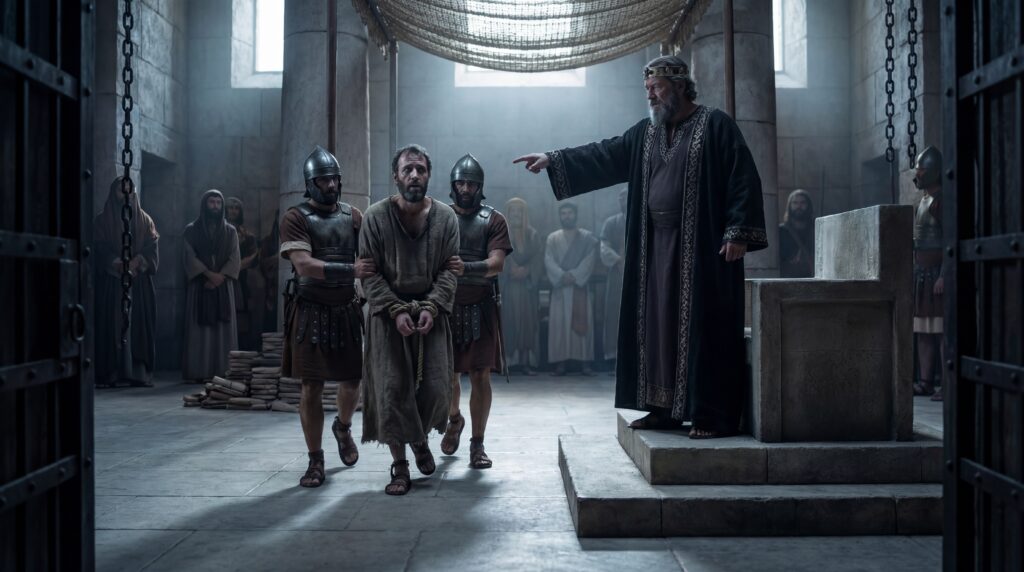
But then the forgiven servant encounters a fellow servant who owes him a comparatively tiny amount. He grabs him by the throat, demanding immediate payment. His fellow servant falls down and begs with the exact same words: “Be patient with me, and I will pay it all.”
The plea is ignored. The forgiven servant throws his debtor into prison.
When the king hears about this, his response is devastating: “You evil servant! Shouldn’t you have mercy on your fellow servant, just as I had mercy on you?” (Matthew 18:32-33). The king reinstates the original debt and hands the unforgiving servant over to the torturers.
Jesus concludes with words that should make us pause: “So My heavenly Father also will do to you if each of you, from his heart, does not forgive his brother his trespasses” (Matthew 18:35).
The Mirror of Our Condition
This parable reflects our own condition before a holy God. We are that first servant, burdened with a sin-debt we could never repay. The Bible tells us the wages of sin is death. That’s what we deserve.
Yet God has made astonishing provision through His Son. 2 Corinthians 5:21 reveals the great exchange: “God made Him who knew no sin to be sin for us, that we might become the righteousness of God in Him.”
At the cross, Jesus poured out Himself in self-sacrificing love. He paid the wages of our sin by His death so that we can receive His gift of eternal life. In the greatest act of forgiveness the universe has ever seen, our sins were placed on Christ and His righteousness was credited to us—a free gift, by grace through faith.
This is more than a legal transaction in God’s court. The word “become” implies transformation. By taking the death we deserved upon Himself, Jesus not only credits us with His perfect righteousness but imparts to us His divine nature. Christ in us enables us to extend the same forgiveness to others that Jesus extended to those who crucified Him: “Father, forgive them, for they know not what they do” (Luke 23:34).
When Religion Becomes Ritual
How do reasonable people come to expect forgiveness for their sins while withholding forgiveness from those who sin against them?
For the ancient Israelites, God established a sacrificial system designed to give them some estimation of the cost of sin. Imagine the gravity of the moment as the sinner laid hands on an innocent animal, then took its life, foreshadowing the sacrifice God would make by giving His own Son.
But over time, these rituals that pointed to Christ became the focus themselves. Without Christ at the center, the rituals lost their meaning.
We face a similar threat today. Our church attendance, our prayers, our service, our healthy habits can become meaningless rituals when Jesus is no longer at the center of what we do. And one clear indicator that Christ has been left outside our heart’s door is our attitude toward those who have wronged us.
If we hold onto an unforgiving spirit, self is at the center. Is the place in your heart where God wants joy to live is inhabited by a grudge, by resentment, by anger at someone who did you wrong—even unspeakable things. Jesus wants to fill that place in your heart, but He won’t do it as long as you keep selfishness there.
Christ’s Love In Me, Christ’s Love Through Me
When Christ dwells in us through the Holy Spirit, the evidence will be our ability to set aside grudges, resentment, and anger. As the apostle Paul wrote, “Therefore, having been justified by faith, we have peace with God through our Lord Jesus Christ” (Romans 5:1). That peace is more than internal well-being—it’s a state of being in right relationship with God and with our fellow human beings.
Ellen White beautifully expressed this: “There is a fragrance about the life, a bloom upon the character, that makes manifest the indwelling of Christ,” Steps to Christ, p. 77.
What fragrance do people associate with you? Do you carry the sweet aroma of forgiveness or the bitter stench of resentment?
Growing in this grace is a lifetime process, not a one-time event. It’s the work of abiding in Christ continually. We must die daily to the desires of the flesh—the flesh wants revenge, wants rights recognized, wants enemies to suffer. We must rise daily to walk in the Holy Spirit, which gives forgiveness even to enemies, kindness to the unkind, love to those who don’t deserve it.
Our Mission to the World
In John 17, Jesus prayed His longest recorded prayer, appealing to the Father for unity among His followers. This prayer for unity is fundamentally a prayer for mutual forgiveness. Unforgiving attitudes and the self-sacrificing love needed for unity cannot occupy the same space simultaneously.
Many Seventh-day Adventists look with excitement to the signs that Jesus is returning soon. But if we don’t allow Christ in us to replace unforgiving attitudes with self-sacrificing love, our reward will be as unwelcome as that of the unforgiving servant.
This is our mission: to reveal the love of Christ to the world. But how can we reveal Christ’s love to others when we refuse to extend His forgiveness? We are called to be living tabernacles, dwelling places of God’s Spirit, demonstrating to a broken world what divine love looks like in human flesh.
The world will believe we are Christ’s disciples by our love for one another. Full surrender to the transforming power of God’s love is the only hope for healing broken relationships in our homes, in God’s church, and in our witness to the world.
Will You Choose Forgiveness?
What grudges, resentment, or anger do you hold onto that are keeping you from receiving the full measure of forgiveness Jesus wants to give you?
When we recognize we’ve been forgiven “millions” in spiritual debt, how can we withhold forgiveness for “thousands”?
My appeal to you is this: Take time at least twice daily, evening and morning, to kneel before the cross and contemplate what Jesus has done to forgive you. Kneeling before the cross each day is the first step in enabling you to offer forgiveness to those you’ve been unable to forgive. It’s the first step in receiving Christ’s self-sacrificing love and having His righteousness revealed in you.
Will you say “yes” to being a forgiven and forgiving person? Will you let Christ’s righteousness shine through you, starting today? Will you join in the mission of revealing Christ’s love to a world desperate for healing and reconciliation?
The cost of unforgiveness is too great. The grace available to us is more than magnificent. Will you choose forgiveness—from the heart—as you’ve been forgiven? If your answer is yes, don’t wait another day — it’s time to begin.