
Are Your Dreams Big Enough?
By Jon Beaty
In 1904, two men stood on the deck of a steamboat chugging down the Cumberland River in Tennessee. E.A. Sutherland and Percy Magan weren’t on a vacation; they were on a mission from God to find land for a new kind of school. They had very little money, a massive vision, and a deep conviction that God wanted a training center for self-supporting missionaries in the South.
As they passed a dilapidated plantation known as the Ferguson farm, Ellen White—who was traveling with them—pointed to the shore and indicated that this was the place.
If you saw the place, you might imagine Sutherland and Magan looking at Ellen as if she’d fallen off her rocker. She was 76 years old! Could her eyes be failing her? Might she have early dementia?
To human eyes, the place Ellen pointed to looked like a disaster. The soil was worn out from years of tobacco farming, the buildings were crumbling, and the price was far beyond their empty pockets. But Sutherland and Magan didn’t look with human eyes. They prayed. Through a series of miraculous events and divine providence, the owner lowered the price, and the money needed for the project appeared just in time.
This is an example of a direct fulfillment of God’s promise:
Believe in the LORD your God, and you shall be established; believe His prophets, and you shall prosper. (2 Chronicles 20:20 NKJV)
That property became Madison College. It serves as a powerful reminder for us today: when we rely on God’s promises, counsel and capabilities instead of our own presumption, reasoning, and resources, dreams that seem impossible become our reality. God is calling us to dream big—not for our own glory, but to see what He can do through a life completely surrendered to Him.
Seeds and Giants: The Biblical Blueprint
It is easy to feel small when you look at the giants in your life—whether that’s a difficult career path, a call to serve, a church project, or a personal struggle.
My parents’ divorce when I was in grade school towered over me like a giant during my teen and young adult years. Their inability to make their marriage work devastated me. I lost friends as the result of having to move to a different state. I went from living a comfortable a middle-class lifestyle where I had almost everything I wanted to living in near poverty. My dad gleaned in orchards and brought home government cheese to feed me and my brother. He collected beer and pop cans along the road to get the deposit so he could provide a Thanksgiving dinner.
However, the Bible reminds us that God doesn’t need a finished forest; He only needs a seed. For me that seed was planted when I made the decision at 15 years old to give my life to Jesus. I can’t say that everything changed in that moment. In that moment, the direction of my life changed. Where there was once despair, the hope of a brighter future took its place. Over 40 years later, I look back with gratitude as I see how God’s blessings have exceeded my hopes and dreams.
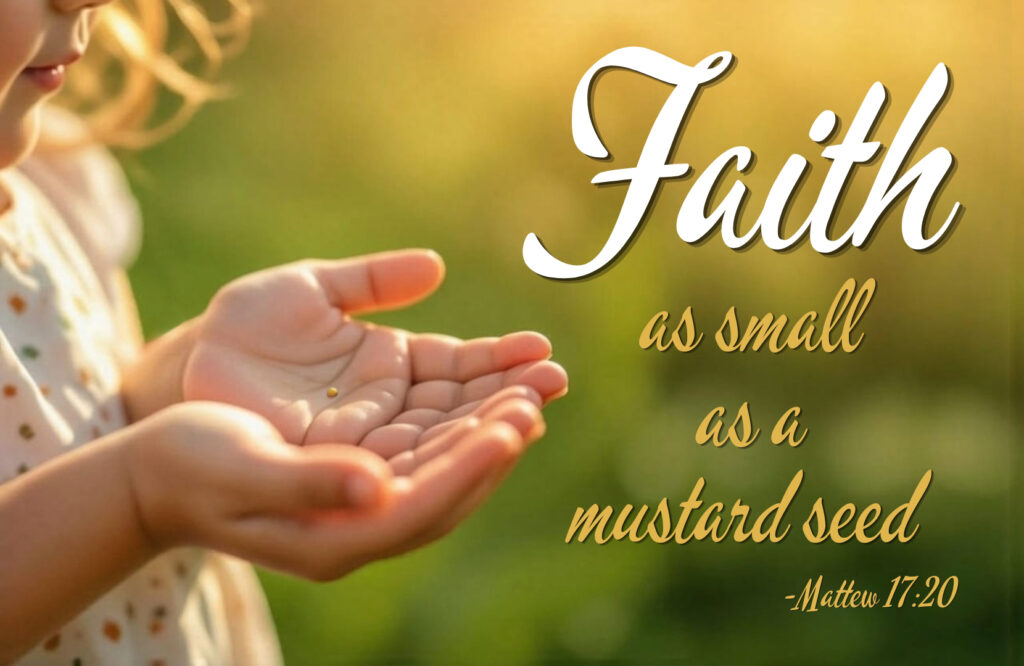
In Matthew 13:31-32, Jesus tells the Parable of the Mustard Seed. He notes that the mustard seed is among the smallest of all seeds, yet when it grows, it becomes a tree so large that birds come and rest in its branches. This is the economy of heaven. Your small “yes” to God, your small prayer, or your small act of faith is the seed. God provides the soil, sunlight and the rain to turn that tiny start into something that provides shade and life for others.
We see this same principle in the story of David and Goliath (1 Samuel 17). David didn’t walk onto the battlefield boasting about his sling-shot skills. He told the giant, “I come to you in the name of the Lord of hosts.” David’s dream wasn’t just to survive; it was to prove that there was a God in Israel. God didn’t need an army to defeat the Philistines that day. He needed a faithful servant, a stone and a sling. When we rely on divine strength, the “impossibilities” in our lives start to look much smaller.
Lessons from Our Adventist Heritage
The story of the Seventh-day Adventist Church is a story of people who were willing to look foolish for the sake of a God-given dream.
Madison College didn’t just stay a small farm. It grew into a world-renowned institution that pioneered the “work-study” program, where students learned both academics and practical trades. From that humble, broken-down farm, hundreds of self-supporting missionaries were sent across the globe. They succeeded because they weren’t relying on government grants or massive endowments; they were relying on the “Madison Blueprint” of faith and hard work. While Madison College closed its doors long ago, its legacy lives on through hundreds of similar ministries inspired by the faith of Sutherland and Magan, and sustained by God’s resources.
Think of James and Ellen White in the early days of our movement. They started with no organized church, no printing presses, and very little food. James White once hauled hay to earn enough money to print the first editions of The Present Truth. They had a “big dream” that this small message would circle the world like “streams of light.” Today, with millions of members worldwide, we are living in the reality of the dream they stayed awake praying for.
Wisdom for the Journey
Ellen G. White’s writings are filled with encouragement for those who feel their dreams are too large for their circumstances. In her book Education, she writes:
“Higher than the highest human thought can reach is God’s ideal for His children. Godliness—godlikeness—is the goal to be reached.” (Education, p. 18)
Notice that she doesn’t say we should aim for what is “realistic.” She says we should aim for “Godliness” and “godlikeness”.
If godlikeness is the goal, can we ever truly say we’ve reached our potential? Is there ever a time for us as individuals or a church to say “I’m rich and increased with goods, therefore growth is no longer needed?”
The opportunities for growth often trigger feelings of fear, doubt, pessimism and complacency. But these are not attributes of God’s character. The God of the Bible is the God that makes the impossible possible. Through Jesus, God creates and transforms the animate and inanimate by His word.
When we surrender our own plans, God can give us His. When we stop trying to manage God’s work with our limited human wisdom, He can empower us in ways that benefit us and others beyond our imagination.
Dreaming God’s Dreams
If you feel stuck or afraid to move forward with a dream God has put on your heart, start with these three practical steps:
- Pray for Divine Vision: Ask God to show you what He wants for your life. Sometimes we dream too small because we are only looking at what we can do. Ask Him to open your eyes to what He can do.
- Pray for Divine Resources: God is the owner of “the cattle on a thousand hills” (Psalm 50:10). If the dream is from Him, the resources—whether they are financial, physical, or intellectual—will follow in His timing.
- Pray for the Faith of Jesus: We don’t just need faith in Jesus; we need the faith of Jesus—the kind of trust that stays firm even when the “Ferguson farm” of your life looks like a ruin; the kind of trust that takes the next step even while the glory on the other side of the cross is a promise not yet fulfilled.
Our Call to Action
The Apostle Paul tells us in Ephesians 3:20 that God is able to do “exceedingly abundantly above all that we ask or think.”
Think about that for a second. Your biggest, wildest dream for God’s kingdom is still just the floor of what He wants to accomplish through you. Don’t be afraid of the “broken-down buildings” or the “empty pockets” in your life right now. As God did for Israel, when He leads you to the promised land, He will provide the way to occupy it.
Are you ready to stop dreaming human dreams and start dreaming God’s dreams?