
Choosing Faith Over Fear
By Jon Beaty
Every day, Satan pressures us to act from fear and rely on ourselves to protect our status, resources, and security. By contrast, God calls us to trust in His promises and power. How can we learn to do that?
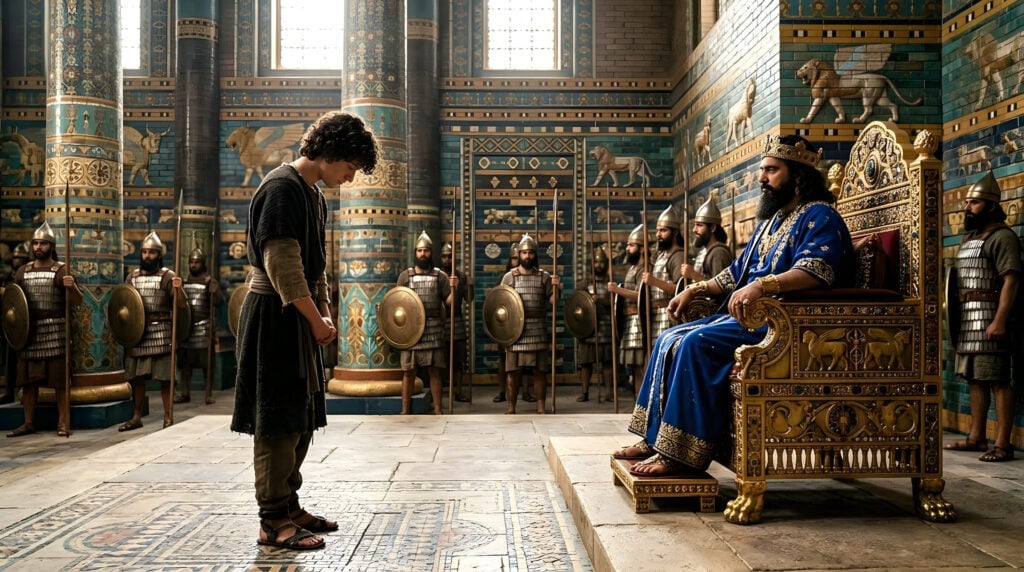
The Bible presents the first scene of the prophet Daniel’s story as a moment of crisis. Jerusalem is under siege by the army of Babylonian King Nebuchadnezzar. This is young Daniel’s home. Soldiers round him up with others and force him on a long journey to Babylon. In all of this, nothing is said about Daniel’s family. At this moment, he is a teenager, alone in the world.
Daniel had every reason to fear. His experience gives us a model of how to overcome fear by faith.
Faith in the Face of Loss
The journey from Jerusalem to Babylon was more than 700 miles by foot without shade from the scorching sun during the day, and without the warmth of a blanket by night. Food and water would have been scarce.
The Bible implies that Daniel would never have a family of his own. The chief of the eunuchs chose Daniel to be trained for service in King Nebuchadnezzar’s palace. No young man would choose an assignment requiring castration to qualify. Daniel wasn’t given a choice.
To say Daniel was in difficult circumstances is an understatement. He was torn from the comforts of home, deprived of his rights and privileges, and separated from his family. As if that were not enough, he also lost his dignity as a man.
We all experience loss, though few of us have suffered as Daniel did. His story should put our own complaints in perspective. Yet one thing mattered even more than everything he had already lost. After losing his home, freedom, family, and future, Daniel faced a greater test: whether he would surrender his integrity. His convictions were now on trial.
Conflict, Courage and Conviction
When everything else is gone, our convictions may be the last thing standing between life and death.
In Daniel’s case, with his three fellow captives Hananiah, Mishael and Azariah, it was Daniel who showed courage in the face of danger. To those not sharing Daniel’s convictions, there was no trial. The choice was simple—avoid conflict and do what you’re told.
Daniel’s conflict began when King Nebuchadnezzar ordered the captives to eat meat and drink wine from the royal table. To most of the young men in training, this seemed like welcome relief after months of meager rations on the journey from Jerusalem. But what others welcomed as a blessing, Daniel recognized as a potential curse.
But Daniel was determined not to defile himself by eating the food and wine given to them by the king. He asked the chief of staff for permission not to eat these unacceptable foods. (Daniel 1:8 NLT)
Generations of mothers have told their children to eat the food placed in front of them, especially when they’re a guest in someone else’s home. Whether the rules of good manners are rational, the importance of following the rules is magnified when a person is a prisoner of war. Punishment for not following the king’s orders was harsh. Consider the fear of Ashpenaz, the chief eunuch:
“I am afraid of my lord the king, who has ordered that you eat this food and wine. If you become pale and thin compared to the other youths your age, I am afraid the king will have me beheaded.” (Daniel 1:10 NLT)
Though we do not know what became of Daniel’s family, it is reasonable to conclude that his parents had taught him well. They surely taught him good manners, but more importantly, they grounded him in the truth that as an Israelite he belonged to God’s chosen people. Daniel understood that God’s commands were not needless restrictions, but safeguards meant to protect His people from the diseases suffered by other nations.
He said, “If you will listen carefully to the voice of the LORD your God and do what is right in his sight, obeying his commands and keeping all his decrees, then I will not make you suffer any of the diseases I sent on the Egyptians; for I am the LORD who heals you.” (Exodus 15:26 NLT)
Promises and Purpose
God’s purpose was not to make the Israelites the healthiest nation on earth. God’s purpose was to raise up a nation to be a blessing to all nations. God’s mission for His chosen people was and always is to be channels of God’s greatest blessings to the world. To accomplish this requires an integrity that reflects God’s righteousness.
Knowing this, Daniel proposed a test to resolve the conflict and safeguard his integrity. Daniel and his three companions would eat vegetables for ten days, and then be compared to the other young men who were eating the king’s best meat and drinking the finest wine. The proposal was accepted: “At the end of the ten days, Daniel and his three friends looked healthier and better nourished than the young men who had been eating the food assigned by the king,” (Daniel 1:15 NLT).
This opening scene in Daniel’s story teaches righteousness by faith. At its heart is trust in God’s commands and the Holy Spirit’s guidance—not merely believing they are true, but relying on them enough to obey, even at personal cost, through the power of God’s grace. As we obey God, we become channels of His love and blessing to the world around us.
Standing by our convictions is easy when nothing is at stake. The true test comes when faithfulness costs us something. In those moments, we must weigh the cost of compromise against the blessings of trust. Satan pressures us to act from fear; God invites us to live by faith.
When we give in to fear, we begin to see life through scarcity—too much trouble, too little help, and no way forward except compromise. But when we stand on God-given convictions and lean on His promises, we open our lives to the grace that enables us to do more than we imagined possible.
That was the experience of Daniel, Hananiah, Mishael, and Azariah. God gave them wisdom, understanding, and influence far beyond what Babylon could provide. When the king tested them, he found them “ten times more capable” than all the wise men in his kingdom.
The same choice stands before each of us today: to be ruled by fear, or to trust God enough to remain faithful.