
Don’t Believe Everything You Think: The Easiest Person to Deceive is Yourself
By Jon Beaty
Many sincere believers who love God and serve Him faithfully still wrestle with a subtle trap: self-deception. We pray, study Scripture, give generously, and stay active in church, while quietly beginning to believe that our spiritual progress or fruitful service comes mainly from our own effort, wisdom, or consistency. We thank God for answers to prayer but assume continued blessings result from our hard work. This self-reliance often masquerades as spiritual maturity.
At its core, this deception is an attempt to establish our own righteousness rather than receiving righteousness by faith. We shift from depending on God’s grace to trusting in what we can build or maintain. The Bible warns that “the human heart is the most deceitful of all things, and desperately wicked” (Jeremiah 17:9, NLT). Left unchecked, this mindset leads us to build “kingdoms” of our own making—much like the ancient king we meet in Daniel 4.
Pride That Builds Its Own Kingdom
King Nebuchadnezzar ruled the most powerful empire of his day. He had already encountered the true God in powerful ways. In Daniel 2, God revealed the meaning of a mysterious dream through the prophet Daniel, and the king honored the God of heaven. In Daniel 3, he witnessed God’s miraculous protection of three faithful Hebrews in a fiery furnace and issued a decree acknowledging their God.
Yet, Daniel 4 records another dream—this one a direct confrontation with the king’s pride. Nebuchadnezzar saw a magnificent tree, tall and strong, reaching to the sky and visible across the earth. It provided shelter and food for every living creature. Then a holy messenger from heaven commanded that the tree be cut down, leaving only the stump and roots bound with iron and bronze. The king himself would be humbled—driven from human society and given the mind of a wild animal until seven years passed.
The purpose was clear: “so that everyone may know that the Most High rules over the kingdoms of the world. He gives them to anyone he chooses—even to the lowliest of people” (Daniel 4:17, NLT). Daniel interpreted the dream and urged the king to repent: “Stop sinning and do what is right. Break from your wicked past and be merciful to the poor. Perhaps then you will continue to prosper” (v. 27, NLT). God gave Nebuchadnezzar 12 months to repent of his pride.
The Boast That Exposed the Heart
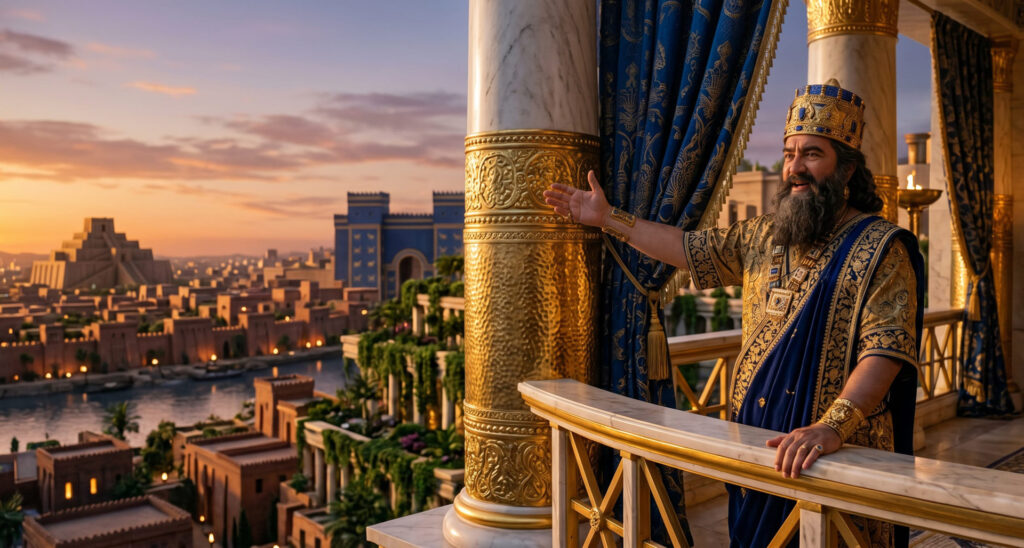
Then, one day, while walking on the roof of his palace and gazing at the splendor of Babylon, Nebuchadnezzar’s self-deception found its voice. He declared, “Look at this great city of Babylon! By my own mighty power, I have built this beautiful city as my royal residence to display my majestic splendor” (v. 30, NLT).
Notice the emphasis: “By my own mighty power.” In that moment he claimed credit for what God had given and sustained. He was attempting to establish his own glory and security through his achievements—a picture of trying to credit himself for his accomplishments and status rather than receiving it as a gift from the Most High God.
Immediately a voice from heaven stripped him of his kingdom and reason. For seven years Nebuchadnezzar lived like a wild animal—his hair like eagle feathers, his nails like bird claws—completely helpless. The man who boasted of building by his own power was reduced to utter dependence.
Humility Opens the Door to Restoration
At the end of that time, everything changed. “After this time had passed, I, Nebuchadnezzar, looked up to heaven. My sanity returned, and I praised and worshiped the Most High and honored the one who lives forever” (v. 34, NLT). When he lifted his eyes in humble acknowledgment of God’s sovereignty, his understanding returned. He confessed, “All the people of the earth are nothing compared to him. He does as he pleases among the angels of heaven and among the people of the earth. No one can stop him or say to him, ‘What do you mean by doing these things?’” (v. 35, NLT).
Nebuchadnezzar’s honor and kingdom were restored—now with greater understanding. The humbled king concluded: “Now I, Nebuchadnezzar, praise and glorify and honor the King of heaven. All his acts are just and true, and he is able to humble the proud” (v. 37, NLT).
This restoration came by grace when Nebuchadnezzar turned in humble dependence and faith toward the God who rules. Righteousness by faith means we stop striving to build or justify our own spiritual standing. It doesn’t mean we sit back and let God do the work. It means we become channels of Divine power, empowered and equipped to do even greater things than we might accomplish by our human strength. In Nebuchadnezzar’s case, he received “even greater honor than before” (v. 36, NLT).
God’s Antidote to Spiritual Self-Deception
For us, Nebuchadnezzar’s story is a mirror. We may not rule empires, but we can build our own versions of Babylon—successful ministries, respected reputations, stable families, or a sense of spiritual superiority. When we begin to think these exist “by my own mighty power,” we fall into the same self-deception. We try to establish our own righteousness through performance rather than resting in the righteousness that comes by grace through faith in Jesus.
Righteousness by faith does not mean we stop doing what is right. Daniel’s counsel to “do what is right” and “be merciful to the poor” still applies. But these actions flow from a heart that has already received God’s grace, not from an effort to earn His favor. As the apostle Paul later wrote, we are saved by grace through faith, not by works (Ephesians 2:8-9). Our good works become the joyful fruit of faith to bless others, not the root of our acceptance with God, or the means to gain status with others.
The Sabbath itself is a weekly celebration of righteousness by faith—we rest from our labors to remember that salvation and spiritual growth are God’s work, not ours. Every Sabbath we are invited to stop building our own kingdoms and receive afresh the gift of God’s rest and approval.
Walking in Humility and Faith
How can we apply this lesson so we do not have to learn it through painful humbling?
- Start each day with honest self-examination. Pray for a fresh baptism of the Holy Spirit and ask, “Search me, O God, and know my heart; test me and know my anxious thoughts. Point out anything in me that offends you, and lead me along the path of everlasting life” (Psalm 139:23-24, NLT). Ask specifically where self-reliance has replaced living faith.
- Credit every success to God. Make it a habit to say—and believe—“By God’s grace…” instead of quietly taking credit. Celebrate what God is doing in others’ lives with the same joy you feel for your own.
- Invite accountability. Share your struggles and motives with trusted family or friends who will speak truth in love. Pride grows in isolation. “As iron sharpens iron, so a friend sharpens a friend.” (Proverbs 27:17 NLT)
- Remember the Sabbath. Each week, remember that your value and security rest in what Christ has accomplished. The Sabbath is our Divine protection against the self-deception that says you must keep producing to be secure.
- Abide daily in Christ. Jesus said, “Yes, I am the vine; you are the branches. Those who remain in me, and I in them, will produce much fruit. For apart from me you can do nothing” (John 15:5, NLT).
Don’t believe everything you think. The easiest person to deceive is yourself—but it does not have to stay that way. Like Nebuchadnezzar, we can choose today to lift our eyes to heaven. God is not waiting to catch us in pride; He is waiting to restore us by grace with the gift of righteousness by faith.