
Love Restored: God’s Plan for Healing Broken Relationships
By Jon Beaty
“What the world needs now is love, sweet love…” These lyrics, penned decades ago, still resonate with a truth that echoes through every generation. Our world is fractured by division, loneliness, and broken relationships. Families struggle, friendships fall apart, and hearts ache with isolation. But there’s hope. As Seventh-day Adventists, we carry a sacred mission: to reveal the love of Christ to a hurting world. This isn’t just a nice sentiment—it’s the very heartbeat of our calling. God’s love, perfectly demonstrated through Jesus, has the power to restore what sin has shattered.
What Is Love, Really?
In a culture that defines love as a feeling or an emotional high, God offers us something radically different. The Bible declares simply and profoundly: “God is love” (1 John 4:8, NKJV). This means love isn’t just something God does—it’s who He is. Every attribute of God’s character reveals true love in action.
Throughout Scripture, from Genesis to Revelation, we see God’s love manifested as self-giving. The ultimate expression of this love appears in John 3:16: “For God so loved the world that He gave His only begotten Son, that whoever believes in Him should not perish but have everlasting life” (NKJV). In giving His Son, God gave Himself to save a lost world. This is the essence of true love—not self-seeking, but self-sacrificing.
Love and the Law
The Bible teaches that God’s law is holy, just, and good (Romans 7:12, NKJV). Because holiness is defined by God’s attributes, and God is love, we can understand that His law is a reflection of His loving character. This is why keeping God’s commandments isn’t burdensome legalism—it’s a supernatural expression of love.
Jesus summarized all the commandments into two great laws: Love God with all your heart, soul, and mind, and love your neighbor as yourself (Matthew 22:37-40, NKJV). True love, then, is demonstrated in obedience to God’s commandments, not out of fear or obligation, but because true love desires what’s best for others.
The Problem: A Love Deficit
Here’s where we face an uncomfortable truth: “All have sinned and fall short of the glory of God” (Romans 3:23, NKJV). To fall short of God’s glory is to fall short in love. Even when we try our best to love, we stumble. James reminds us that “whoever shall keep the whole law, and yet stumble in one point, he is guilty of all” (James 2:10, NKJV).
At the heart of every broken relationship, every bitter divorce, every family feud, and every lonely heart is the same root problem: we love ourselves more than we love God or others. This self-centered love—or rather, lack of true love—separates us from God and fractures our relationships with each other.
This problem didn’t originate with humanity. Sin began when Lucifer, the highest of angels, questioned God’s goodness and rejected His love. Pride entered his heart, and he began to trust himself more than God. His rebellion spread to a third of heaven’s angels (Revelation 12:7-9) and eventually to our world, where Satan planted the same seed of doubt in Eve’s heart: “Has God really said…?”
When Adam and Eve chose to doubt God’s love and disobey His command, sin entered the human family. Their eyes opened not to wisdom, but to shame, fear, and guilt. The relationship with God broke. The relationship between husband and wife strained. And the brokenness extended to their children, culminating in Cain murdering Abel.
We live with the ripple effects today: strained marriages, fractured families, inner loneliness, guilt, fear, and ultimately death. Isaiah captures our predicament: “Your iniquities have separated you from your God; and your sins have hidden His face from you” (Isaiah 59:2, NKJV).
God’s Rescue Plan: The Sanctuary
But God doesn’t abandon us in our brokenness. From the moment sin entered the world, He initiated a divine plan to bridge the chasm and restore us to fellowship with Him. That plan was revealed through the sanctuary system: “And let them make Me a sanctuary, that I may dwell among them” (Exodus 25:8, NKJV).
The Old Testament sanctuary wasn’t just an ancient worship tent—it was God’s grand object lesson, illustrating how His self-sacrificing love restores broken relationships through Christ our Righteousness. Every detail, from the furniture to the services, whispered of redemption and pointed to God’s love revealed in Jesus.
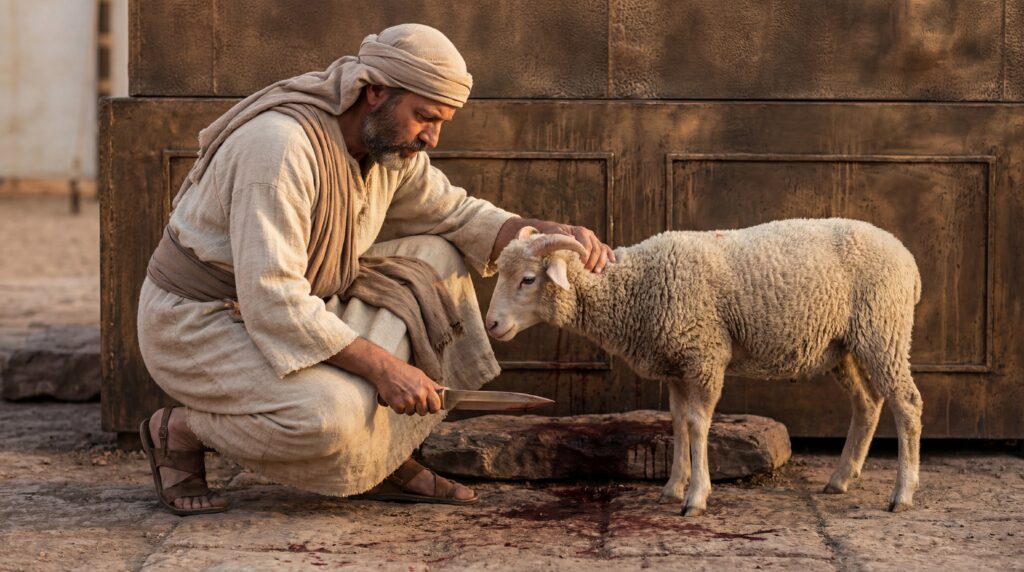
At the heart of the sanctuary stood the bronze altar, where innocent animals were sacrificed day after day. Imagine being an Israelite, placing your hands on a spotless lamb, confessing your sins, and then ending its life by a knife held in your hand. The weight of that moment—feeling innocent blood shed because of your wrongdoing—pointed directly to Jesus, “the Lamb of God who takes away the sin of the world” (John 1:29, NKJV).
God Himself provides the substitute. The penalty for sin is death, but in His love, God pays the price we couldn’t pay. This is Christ’s imputed righteousness—His perfect life credited to our account, covering our guilt and granting us eternal life as a gift.
But restoration goes deeper. After the altar came the bronze laver, where priests washed before entering the Holy Place. This represents our repentance, baptism, and daily cleansing by the Holy Spirit. God doesn’t just want to forgive us—He wants to transform us.
This is Christ’s imparted righteousness, where the Holy Spirit takes up residence in our hearts, forming Christ’s character within us and enabling us to love as He loves. As Paul writes, “Do you not know that your body is the temple of the Holy Spirit?” (1 Corinthians 6:19, NKJV). We become living sanctuaries where God abides, transforming us from the inside out.
Two Gifts, One Gospel
Ellen White beautifully summarized this dual blessing: “The righteousness by which we are justified is imputed; the righteousness by which we are sanctified is imparted. The first is our title to heaven, the second our fitness for heaven” (The Review and Herald, June 4, 1895).
Justification brings peace with God through faith in Christ’s sacrifice: “Therefore, having been justified by faith, we have peace with God through our Lord Jesus Christ” (Romans 5:1, NKJV). The verdict changes from “guilty” to “not guilty.” The barrier of sin crumbles. Sanctification follows, as the Holy Spirit empowers us to grow in grace and reflect Christ’s self-sacrificing love in our daily lives. With God dwelling in us, broken marriages can mend, estranged families can reunite, and bitter enemies can become friends.
Love Restored in Your Life
The sanctuary services required daily sacrifices—morning and evening. While we no longer sacrifice animals, the principle remains: we need to remember Christ’s sacrifice daily with prayers of thanksgiving. If you want to hate sin and love righteousness, start and end each day at the foot of the cross, expressing gratitude for the price paid by Jesus for your sins.
God wants to rebuild the sanctuary in your heart. This happens when we choose to die to selfishness and surrender to Jesus’ self-sacrificing love poured out on the cross.
If broken relationships weigh on your heart today, if guilt and fear separate you from God’s peace, if you long for the transforming power of true love—go to Jesus. Let His imputed righteousness cover you. Let His imparted righteousness remake you. And as His love fills your heart, watch as He uses you to reveal that same love to a world desperately in need.
What the world needs now is love, the sweet love of Christ living in us.