
The Writing on the Wall is About You
By Jon Beaty
Looking back after my first summer on staff at Big Lake Youth Camp it was the best summer of my life. The experience exceeded my expectations. I didn’t realize that I failed to meet the camp director’s expectations. When friends were receiving letters from the director inviting them to return and I had not, I worried. After weeks without word, I mustered up the courage to call the director. I asked why I hadn’t received a letter. His response made my heart sink.
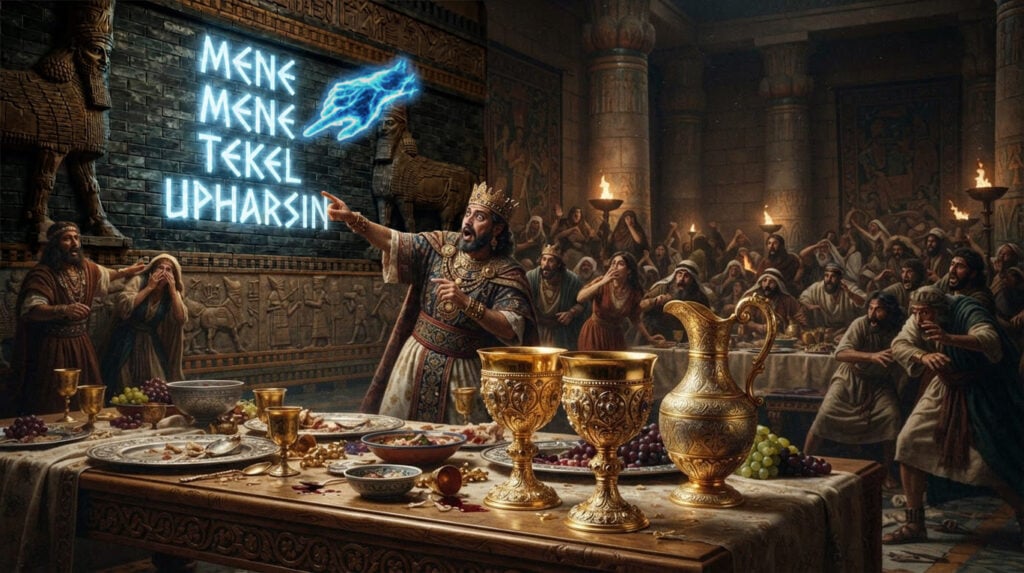
Late in the prophet Daniel’s career as an advisor to kings, he received a summons to appear before King Belshazzar. The king was hosting a lavish feast with a thousand of his highest officials. The feast featured the golden vessels taken from the Jerusalem temple by his father King Nechadnezzar. These pitchers and chalices plundered from God’s holy sanctuary represented God’s character, symbolized by the gold from which they’d been forged. Belshazzar decided to defile these vessels by drinking wine from them to toast his pagan gods.
God will be the first and the last to confront contempt for His holiness. He does this to reveal His greatness. Contrary to the greatness claimed by earthly kings who surround themselves with worldly riches and military power, God’s greatness is displayed in self-sacrificing love. This love is revealed in the sacrifice of God’s only Son to break the power of sin over our lives and restore us to a loving relationship with Him. When used in the temple, these gold vessels were tools in the lessons on God’s love taught by the sanctuary services.
When Belshazzar crossed the line, God responded with immediate judgment. The time had arrived for God to begin to return the Jews to their homeland and to prepare the way for the Messiah’s arrival. Belshazzar’s reign would end that night, as Cyrus, who God called “My shepherd,” arrived to send God’s chosen people home and fulfill a prophecy in which Cyrus was named by Isaiah 173 years earlier (Isaiah 44.28).
Midway through the feast, a disembodied hand appeared, writing four words on the palace wall: MENE, MENE, TEKEL, UPHARSIN. The king trembled so violently, his knees knocked together. At the queen’s suggestion, Daniel was brought in to interpret the message. The heart of the warning lay in the word TEKEL: “You have been weighed in the balances, and found wanting.”
During that hard phone call with the camp director, I realized I had been weighed in the balances and found wanting. I lacked the enthusiasm required for camp ministry. I pleaded for mercy, promising I would work harder if given another chance.
A foundational truth of the Gospel is that we are all weighed in the balances and found wanting. We long to live forever in peace, prosperity, and bliss, yet we are unworthy of such a life. It is a life reserved for the righteous. Had we committed only one sin, we would be unrighteous enough to deserve the lawful penalty of eternal death.
Fortunately, the Gospel offers something far better than a second chance to prove ourselves. God doesn’t demand that we earn our way back—because we can’t. Instead, Jesus bridged the gap between God’s holy law and our human failure through His own perfect obedience on the cross.
The camp director chose to extend mercy, and I returned to camp that next summer with a renewed heart. But the infinitely better story is that God offers us ultimate mercy through His Son.
The writing is on the wall for all of us. The choice is ours: will we continue trying to earn God’s favor through our own efforts, or will we surrender and accept His freely given grace?